01
Classical & Operant Conditioning
Pavlovian learning, conditioned and unconditioned responses, reinforcement, punishment, reinforcement schedules, fear learning, behaviour change and ethical responsibility.
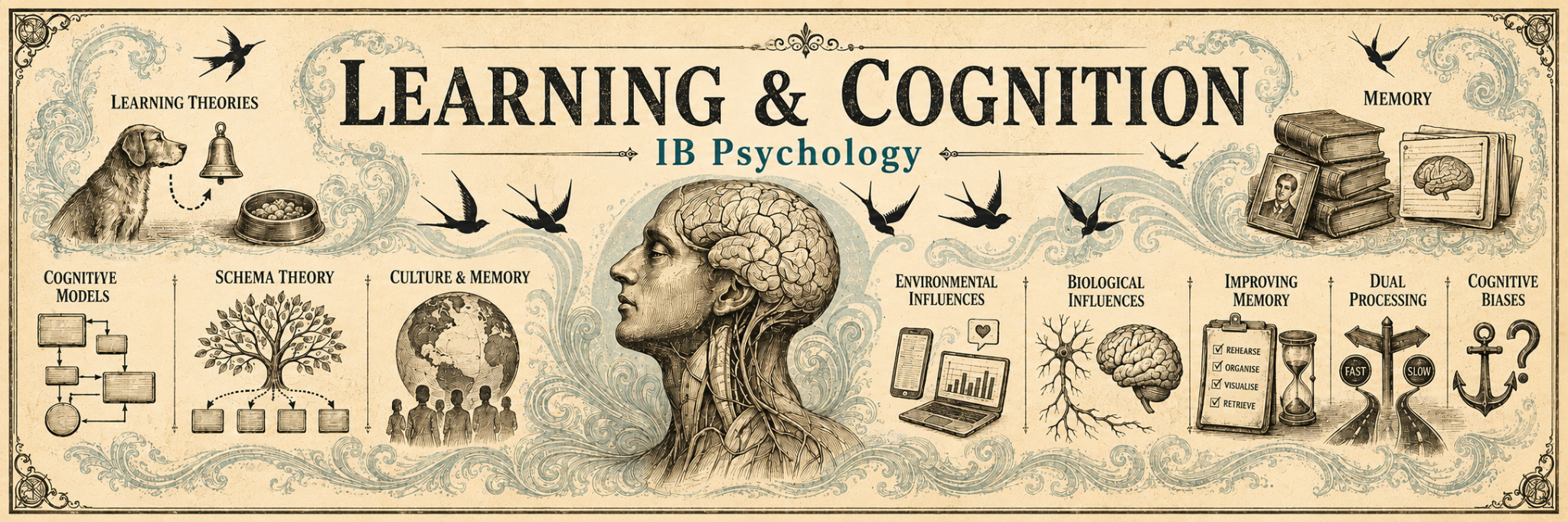
This unit examines how learning, memory and decision making develop through the interaction of cognitive, biological, sociocultural and Indigenous perspectives. Students apply psychological evidence and evaluate models and studies. The unit also contributes the experimental method to the four Class Practicals completed across the course in preparation for Paper 2.
Pavlovian learning, conditioned and unconditioned responses, reinforcement, punishment, reinforcement schedules, fear learning, behaviour change and ethical responsibility.
Attention, retention, reproduction and motivation; modelling, behaviour change, Bandura's Bobo doll study, the Food Dudes intervention and links to mirror neurons.
Short and long term memory; semantic, episodic, procedural, perceptual and emotional memory; the engram, autobiographical memory, facial recognition and prosopagnosia.
Atkinson and Shiffrin's model, sensory memory, short term memory, long term memory, attention, rehearsal, capacity, duration, serial position effects, HM and Clive Wearing.
The phonological loop, visuospatial processing and central executive; dual task research, articulatory suppression, cognitive load, multitasking and Landry and Bartling.
Schemas, cognitive scripts, schema activation, reconstructive memory, Anderson and Pichert, theoretical constructs, construct validity and evidence from neuroscience.
Indigenous knowledge systems, spatial memory and songlines; emic and etic approaches, cultural bias and WEIRD sampling through Kearins, Kulkofsky, Rogoff and Waddell, and Cole and Scribner.
Cognitive load, digital technology, the Google effect, cognitive offloading, social media, memory and attention through Sparrow et al., contrasting perspectives and, at HL, graph analysis.
Neurotransmission, acetylcholine, memory consolidation and localisation of function through Rogers and Kesner, Antonova et al., fMRI evidence, nicotine, Alzheimer's disease and ethical evaluation.
Memory palaces, mnemonic strategies, spaced repetition, Indigenous memory methods, Reser et al. and comparison of biological, cognitive and sociocultural perspectives.
System 1 and System 2 thinking, automatic and analytical processing, the cognitive miser, intuitive errors, decision making, reductionism and soft determinism.
Confirmation and anchoring biases, applied decision making, survey based demonstrations, experimental design, causality and statistical analysis.
Explain and apply learning theories, memory models and cognitive processes while comparing biological, cognitive, sociocultural and Indigenous perspectives.
Identify variables, experimental designs, sampling methods and controls, then plan ethical research with informed consent, confidentiality, debriefing and protection from harm.
Analyse studies through bias, causality, change, measurement, perspective and responsibility, with attention to validity, reliability, generalisability and cultural relevance.
Interpret graphs, descriptive statistics and inferential tests, including statistical significance and the Mann Whitney U test, to draw evidence based conclusions.
Apply psychology to behaviour change, memory improvement, education, technology and everyday decisions, and compare different ways of investigating the same question.
Construct concept based Paper 1 responses, document and evaluate the Learning & Cognition experiment for Paper 2, compare research methods, propose an alternative design and, at HL, interpret source based data.
Aligned with the IB Psychology assessment model for first assessment in 2027.
Students explain and apply learning, memory and decision making content, evaluate research and construct concept based responses. Mock Paper 1 work is embedded in the conditioning and improving memory topics.
Paper 2 draws on the four Class Practicals completed across the course. Learning & Cognition contributes the true or quasi experiment. Students describe its method, link a concept, compare methods and propose an alternative design; they also evaluate an unseen study using two or more concepts.
The Environmental Effects HL extension develops source, graph and statistical interpretation alongside methodological and cultural evaluation of research findings.
Students conduct a true or quasi experiment with at least five participants. Possible areas include reconstructive memory, analytic and holistic attention, anchoring bias, or music and memory. Students manage ethics, record the method and findings, and evaluate the experiment for Paper 2.
Students complete a responsibility worksheet using Watson and Rayner and Meyer and Chesser, apply conditioning terminology, and respond to a mock Paper 1 task.
Students analyse Bandura's Bobo doll study and the Food Dudes intervention through variables, design, controls, bias, causality, measurement, responsibility and behaviour change.
Students reflect on and represent their earliest memory, complete a memory types worksheet, and explore facial recognition, prosopagnosia and the fusiform face area.
Students conduct a serial position and reconstructive memory demonstration, graph the results, compare HM with Clive Wearing, and complete the HM dialogue and content quiz.
Bounce and Brain and See and Speak demonstrations lead into Landry and Bartling methodology analysis and an ethical research plan about phone use while driving.
Students apply schemas to the Woolworths fire case, complete an Anderson and Pichert role based activity, and calculate the mean, standard deviation and Mann Whitney U before graphing results.
Students link concepts to cross-cultural studies, explore transactional and communal Indigenous memory, redesign a study beyond WEIRD sampling, and compare emic and etic approaches.
Students evaluate Sparrow et al., debate phone use, compare Nicholas Carr's perspectives and apply cognitive load. HL students also interpret and critique eight technology and learning graphs.
Neurotransmission and Rogers and Kesner worksheets, Antonova evaluation, a nicotine and Alzheimer's claim-evidence-question task, and ethics cost-benefit analysis connect biology to memory.
Students test a memory palace, compare spaced repetition and Indigenous approaches, analyse Reser et al., evaluate perspectives, and complete mock Paper 1 work.
Reasoning demonstrations and an everyday laptop purchase task develop application of System 1 and System 2 thinking before Paper 1 explanation and application practice.
Students complete a rule testing task and an anchoring survey demonstration, calculate the Mann Whitney U, and critique the design, measurement and causal claims.