01
Cognitive Development: Foundations & Milestones
The meaning of cognitive development, changing views of childhood, Locke, Rousseau, Binet, Freud and Piaget, developmental milestones, brain change and the interpretation of age-related patterns.
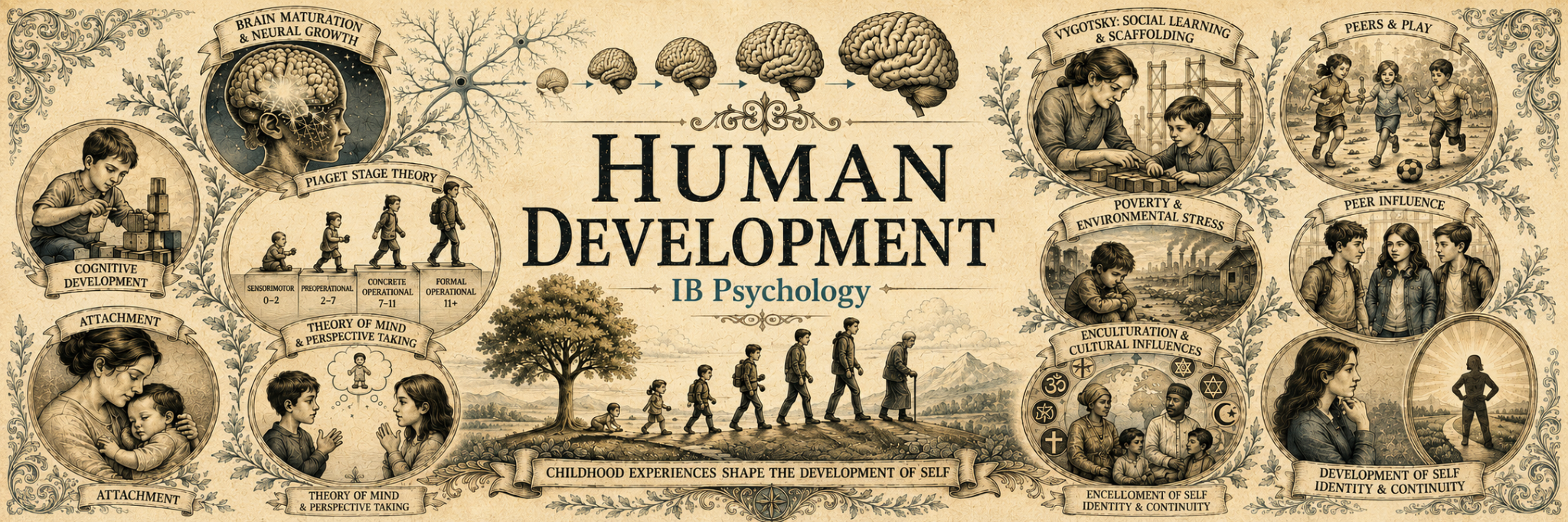
This unit traces cognitive development and the development of self through biological maturation, stage and continuous models, peers and play, poverty, Theory of Mind, attachment, enculturation, peer influence and childhood experiences. Students compare perspectives, evaluate developmental evidence and apply bias, causality, change, measurement, perspective and responsibility. The unit contributes the observation method to the four Class Practicals completed across the course for Paper 2.
The meaning of cognitive development, changing views of childhood, Locke, Rousseau, Binet, Freud and Piaget, developmental milestones, brain change and the interpretation of age-related patterns.
Myelination, synaptic pruning, specialization, critical and sensitive periods, deprivation and recovery, brain imaging, Hubel and Wiesel, Rutter, Giedd et al. and Koluchova.
Piaget and Vygotsky, discrete stages and continuous change, object permanence, conservation, scaffolding, private speech, cultural and educational influences, construct validity and age-appropriate measurement.
Definitions and cultural understandings of play, Parten's stages, free and structured play, peer acceptance and rejection, Vygotsky, Pepler and Craig, Boyette and naturalistic observation.
Risk and protective factors, scarcity and cognitive load, chronic stress, nutrition, opportunity, intervention and domino causality through Mani et al., Kar et al., Farah et al., Noble et al. and Evans and Schamberg.
Desire understanding, false-belief tasks, theory theory, simulation theory, language, executive function, culture, bilingualism, Repacholi and Gopnik, Goetz, construct validity and research bias.
Naturalistic, overt, non-participant observation of adolescent study-group dynamics, operational behavioural categories, opportunity sampling, time sampling, two independent observers, percentage agreement and Paper 2 evaluation.
Attachment, contact comfort, internal working models, attachment styles, culture, adult relationships, Bowlby, Ainsworth, Harlow, van IJzendoorn and Kroonenberg, Hazan and Shaver, animal evidence and responsibility.
Cultural learning, gender roles, Social Learning Theory, Social Identity Theory, filial piety, independence and interdependence, Endendijk et al., Hilliard and Liben, Chao, Yeh and Bedford, Lewis et al. and cultural measurement.
Self-esteem, belonging, rejection, bullying, social comparison, identity, the looking-glass self, sociometric status, Coie and Dodge, Taylor and Armes, observation, reciprocal causality and ethical school research.
Poverty, emotional neglect, refugee experience, resilience, identity, self-worth and agency, the Bucharest Early Intervention Project, the Minnesota Longitudinal Study, Alharbi et al., Kuru et al., Betancourt et al. and methodological responsibility.
Trace cognitive, biological, social and identity development across age and context while distinguishing gradual change, stages, critical periods and sensitive periods.
Compare Piaget and Vygotsky, theory theory and simulation theory, biological and sociocultural explanations, and culturally situated or Indigenous perspectives.
Evaluate experiments, quasi-experiments, naturalistic observations, longitudinal and cross-sectional designs, case studies, brain imaging, self-report and sociometric methods.
Operationalize developmental constructs, design age-appropriate tasks, interpret images and observational data, assess construct and ecological validity, use triangulation and calculate inter-rater agreement.
Apply bias, causality, change, measurement, perspective and responsibility to theories, studies, classroom activities and the formal observation practical.
Address consent, assent, privacy, withdrawal, vulnerable populations, animal welfare and stigma; verify sources and AI claims; and communicate developmental evidence without deterministic overstatement.
Aligned with the IB Psychology assessment model for first assessment in 2027.
Students explain and apply Human Development content and construct concept-based responses. The materials include developed Section C work on change, causality, bias, perspective, measurement and responsibility.
Paper 2 draws on the four Class Practicals completed across the course. Human Development contributes the observation. Students document its aim, setting, sampling, operationalization and procedure, apply concepts, compare methods and propose an alternative design.
Students reflect on personal development, build a milestone timeline, order fifteen milestones and compare historical assumptions with contemporary developmental evidence using the presentation's answer sequence.
Students interpret brain scans, apply maturation terminology, evaluate Rutter, Giedd et al. and Koluchova, examine imaging limitations and respond to responsibility questions concerning children and sensitive data.
Piagetian demonstrations, construct-validity evaluation, Vygotsky applications, a Lego scaffolding task and the design of an age-appropriate cognitive measure lead into theory comparison and concept-based writing.
Students define play, design a naturalistic observation, evaluate Pepler and Craig, present an evidence-based case for outdoor play, analyse Boyette through an emic perspective and reflect on Indigenous ways of learning.
Students classify risk and protective factors, examine scarcity and intervention evidence, evaluate Evans and Schamberg, map domino causality and redesign a replication using stronger sampling, triangulation and controls.
Desire and false-belief demonstrations, comparison of theory theory and simulation theory, Goetz methodology analysis and an AI source-verification exercise develop bias, perspective and evidence-checking skills.
Students conduct an overt, structured, naturalistic, non-participant observation in a teacher-approved study setting. They pilot five operational codes, time-sample every 30 seconds for 10 minutes and calculate agreement between two observers for Paper 2.
Students apply attachment theory to a migration case, critique an online attachment measure, perform attachment-style scenarios, compare human and animal evidence and evaluate responsibility in research involving children and animals.
Students compare Social Learning and Social Identity explanations, evaluate causality, analyse gender in children's books and examine filial responsibility, ageing and measurement across cultural and generational contexts.
Students classify positive and negative peer influence, apply social comparison and the looking-glass self, evaluate Coie and Dodge, design ethical school research and build a concept map linking causality, change, measurement and perspective.
Students analyse emotional neglect, refugee experience and resilience through instructional vignettes and the Amir case, identify interpretive biases, triangulate different perspectives and write developed conceptual paragraphs.